
mimOE operationalizesthe AMD X100for Agentic AI
Balanced silicon plus the Agentix Operating Engine: production Agentix, measured across three companion studies.
 ×
×
Three papers, one argument
Every instrument below is drawn from these. Read each online or download the PDF; each quantitative claim ties to the methodology note below.
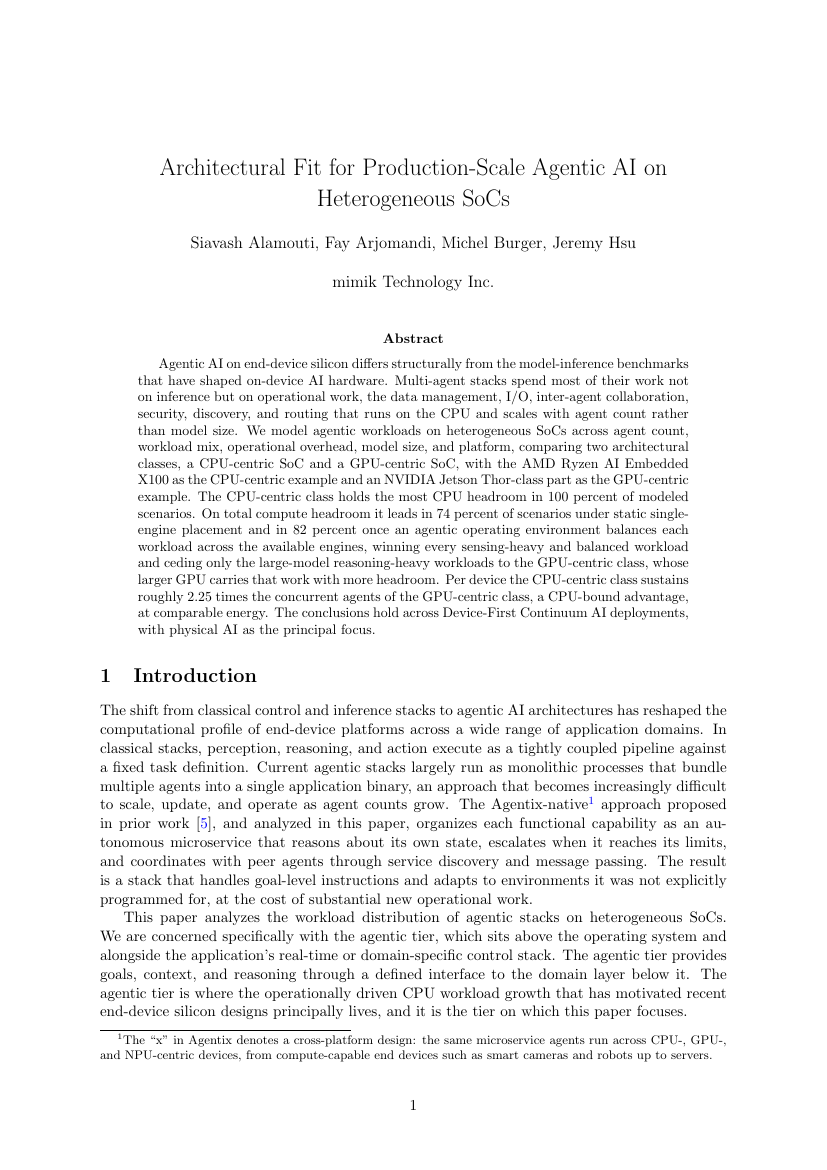
Architectural Fit for Production-Scale Agentic AI on Heterogeneous SoCs
Why a balanced SoC leads CPU headroom in 100% of modeled scenarios and sustains ~2.3× the concurrent agents.
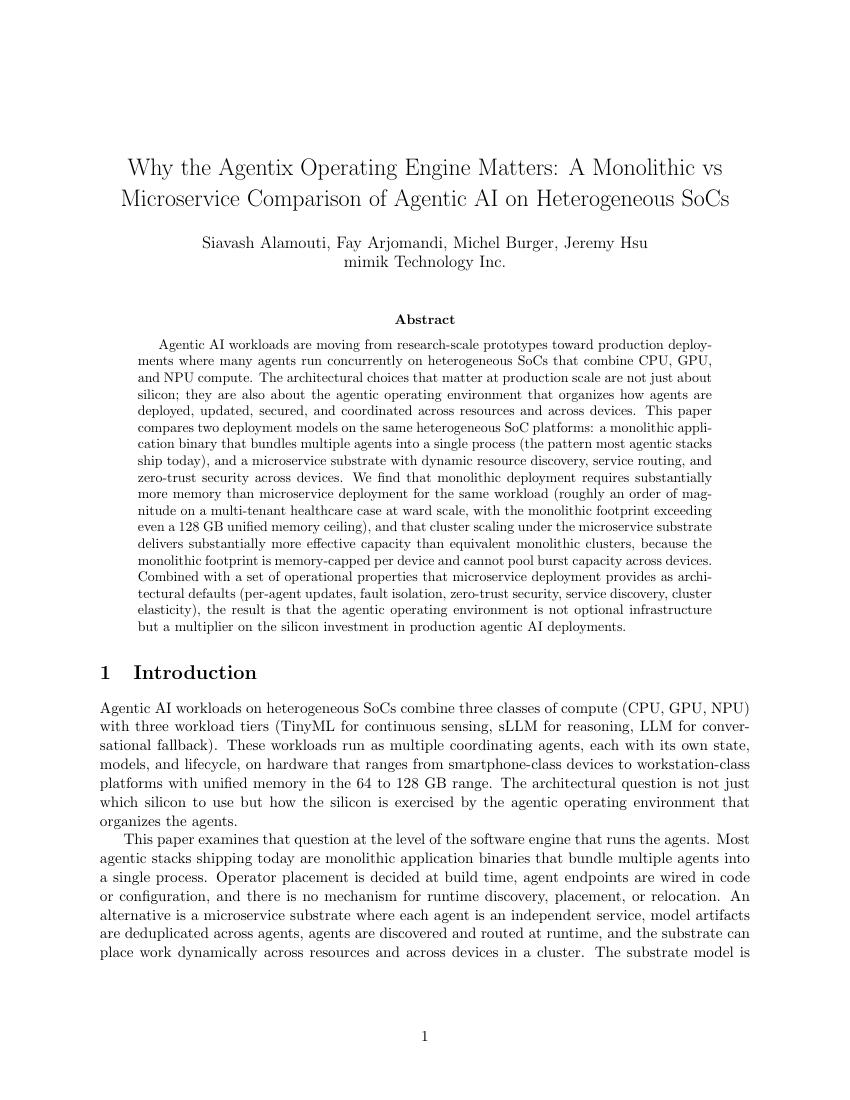
Why the Agentix Operating Engine Matters: Monolithic vs Microservice
mimOE, not just the silicon, sets production scale: dramatically lower memory per device and capacity pooled across a fleet.
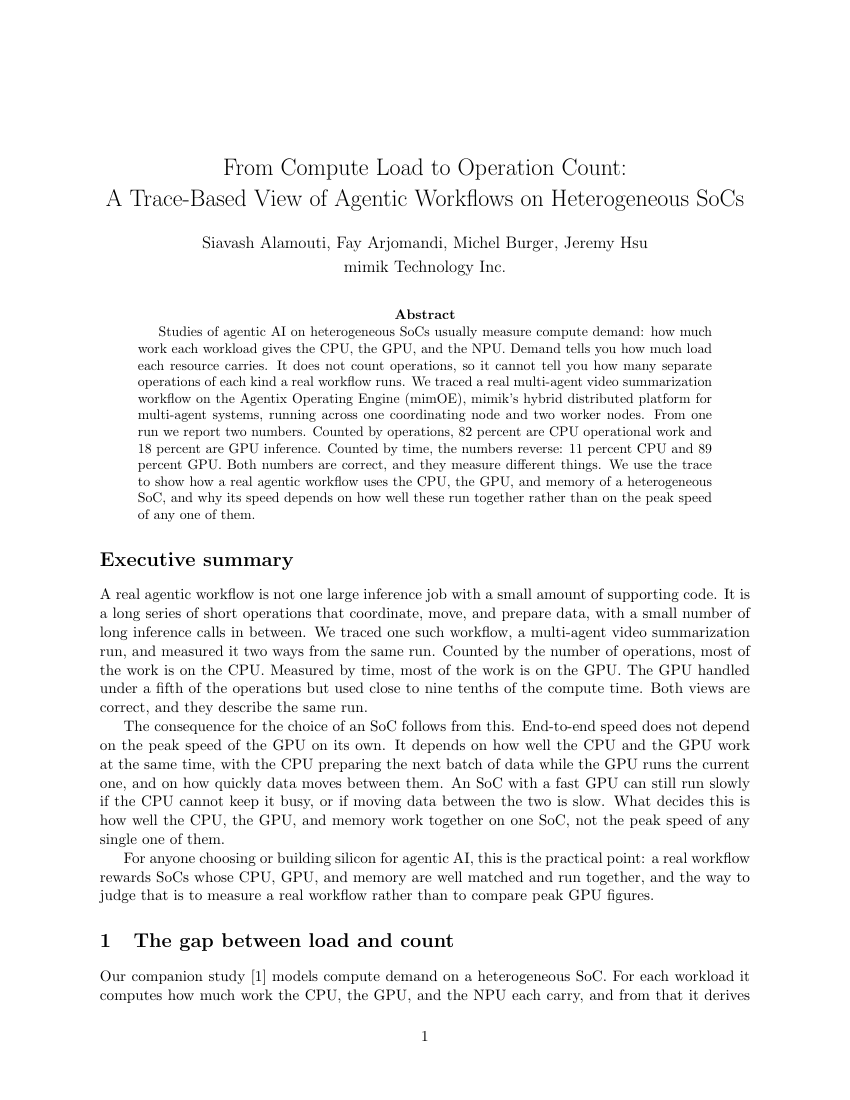
From Compute Load to Operation Count: A Trace-Based View of Agentic Workflows on Heterogeneous SoCs
A real workflow trace: by operation count the CPU runs 82% of the work; by time the GPU runs 89%, and that inversion decides SoC choice.
From one model to a fleet of agents
Production AI is moving from a single large model to fleets of small agents that perceive, reason, and act together. The agents spend most of their time coordinating: routing, security, discovery, state, and observability. That work runs on the CPU and cannot move to a GPU or NPU. So the deciding question is capacity: how many agents a device runs before a resource binds, measured workflow by workflow, resource by resource.
A balanced SoC wins
An analytical model across agentic workloads shows the architecture, not raw peak throughput, decides production scale. A balanced CPU / GPU / NPU SoC leads across the broad range of coordination-heavy work, which lives on the CPU. A GPU-centric device stays the stronger fit for single large-model workloads.
Agentic AI is operations-bound, not FLOPS-bound.
Match the architecture to the workflow
The advantage of the balanced, CPU-centric archetype grows with the coordination intensity of the workflow. It is the hedge when the workload mix is uncertain or will evolve. The GPU-centric archetype stays the stronger fit where a single large model is the binding resource.
Operations, not just FLOPS
One real multi-agent run, read two ways. Count the operations and the CPU dominates; measure the time and the GPU dominates. The same workload inverts depending on what you measure, which is exactly why a balanced SoC wins.
Both are true. Speed comes from CPU, GPU and memory running together, not from any single peak number.
mimOE multiplies the silicon
The same chip, run as microservices by mimOE, needs far less memory per device, and pools the freed headroom across the fleet. Capacity becomes a property of the operating environment, not just the part number.
What mimOE adds, by default
Load once, share everywhere
One shared copy of each model instead of a copy per agent, so a single device holds a whole fleet.
Per-agent isolation and updates
Each agent is an independent microservice: update or fail one without touching the rest.
Zero-trust security and discovery
Authentication tied to agent identity, with dynamic service and resource discovery, as defaults.
Places work and pools across a fleet
Routes each tier across CPU, GPU and NPU, and pools and fails over across devices.
Silicon sets the ceiling. mimOE distributes the work across CPU and GPU so you can use it.
A year of building with AMD
Announced July 2026 after a year of joint engineering, mimOE Embedded Edition is purpose-built for the AMD Ryzen AI Embedded X100 Series, from industrial controllers to autonomous systems, with multi-agent choreography, zero-trust security, offline-first, and multi-cloud when needed.
“The industry has solved intelligence. It has not solved operationalization, and the tools we use in the cloud today do not fit Agentix-Native systems. These are living systems that behave differently by nature; you cannot bolt existing tooling onto them, which is why mimOE and the tools around it are purpose-built for the Agentix era. We run on it ourselves, every day; that is how we move fast and stay flexible as we scale.”
“Agentic AI is shifting compute toward workloads that exercise the CPU, GPU, and NPU together. The AMD Ryzen AI Embedded portfolio was designed for that balance, and with mimik's mimOE running on the platform, our customers can run more agents on the same device and serve more of their own customers per deployment, moving from design-in to production Agentix-Native deployments faster.”
Measure it on your own X100
The findings on this page are modeled and trace-checked. Agentix Benchmarking runs the same class of workflow on your own hardware and reports what it actually carries: verified completion, the full trace, cost and latency. Download the 3-in-1 pack, point it at your X100, and read your own numbers.
Figures come from design-level modeling using published specifications; full X100 CPU specifications were modeled from the closest public AMD part. Comparisons are against an NVIDIA Jetson Thor-class platform per published specifications. Memory and fleet figures are modeled and illustrative. Produced by mimik in collaboration with AMD.
×